|
Confessions of a Media Critic By Barrie Zwicker
Not long ago I was one of a few people invited to speak at what may have been a significant meeting, a retreat for CBC Radio producers. They settled into an old inn in the countryside to reconsider the direction of CBC Radio's feature programming. How useful the retreat turned out to be, or will turn out to be, I don't know. What I do know is that I was dissatisfied with my contribution. I've spent some time trying to figure out why. It was Max Allan Allen of CBC's Ideas series who included me on the speakers' invitation list. Max among other things is a restlessly thoughtful media critic. Since non-news programming was the focus of concern, Max presumably reasoned that the news was the most appropriate yardstick against which to measure. At the retreat I prefaced my critique of news by voicing my concerns about the fate of the earth, concerns which permeate almost everything I think about and certainly my judgments of media performance. I personally feel every day the erosion of our biosphere and the threat hanging over us minute by minute of obliteration from the insanely excessive stock of weapons of mass destruction. In my deeply-held opinion it has not been for some time now a time for business as usual, least of all in journalism. I then went on to criticize the news. I must go out of my way here to emphasize that I was — and am in the main in what follows here — specifically criticizing the CBC Radio news we hear on the hour. This news, as Max Allen has documented, consists about five-sevenths of the time of death, disaster and destruction, snippets of usually de-contextualized reports of violence and mayhem: bombings, derailments, hurricanes, shootings, earthquakes, murders, riots, hostage-takings, hijackings, crashes on land, at sea and in the air, explosions, kidnappings . . . Because the world is so in need of greater understanding of process
— patterns of violence (and co-operation), trends (good
and bad), roots and history and the context of I was led at the retreat not just to venture, but to assert, that the news makes me sick, that I find it worse than useless, that all-in-all it would be better not broadcast. There was more to the retreat, but for the moment my concern with it ends here, and my concern with myself in relation to it starts. After my outburst I regretted it. I regretted the simplistic over-statement which was almost a mirror image of one of the unhealthy aspects of the news I criticized. New layers of projection continually show themselves. Reaction to my outburst was mixed. A news person took strong exception, and little wonder. The ever-civilized Lister Sinclair offered some gentle remarks which upheld the value of reasonableness.
When the news bombs . . .
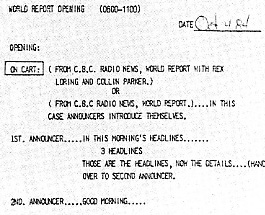
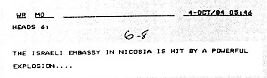
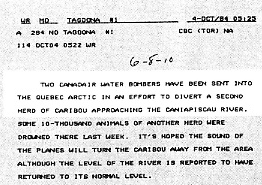
All script, in order, from "The World at Eight," CBC Radio News, 4 October 1984 Looking back on it, I realized that anger was probably dominant in my approach that afternoon, as it is so frequently when I listen to those hourly radio newscasts — this interminable stuttering of psychological warfare against the population, clothed in the ineffable bona fides of news authoritativeness, read by decent, competent announcers, scripted by my former journalism students, accepted as their perceptual environment by my friends and neighbours and to some extent even my family. My confessions are to explore the roots of my anger. Part of my anger is that there appears to be relatively little sharing among most media people of my sense of the danger our world — life-faces. It's as if most know nothing or care not nearly enough . . . and bombs . . .
of what is represented by the doomsday clock on the cover of The Bulletin of the Atomic Scientists having been re-set at four minutes to midnight. When society's firemen deny they smell smoke they endanger me. Fear provokes anger. It was the same story again at the producers' retreat. No one as I recall picked up on my comments about the state of the world as constituting the ultimate context for programming decisions. I'm sure it's not that no one there shares the concern. I know for a fact several do. It would just be a bit reassuring if once in a while someone would voice agreement, would pick up in an articulate way on the implications. Alternatively, or coincidentally, an important root of my anger is frustration that I don't communicate successfully enough to provoke a useful response. People in the peace and social justice field understand the connections between the media performance and the state of the world; they respect the power of communication more than its wielders do. At this particular retreat, I failed to specify another reason for my unhappiness over the news. And that failure of mine contributed further to my frustration, although it was only latent at the time. The assumptions behind so much of the news simply don't square with the world as I understand it. The assumptions are in a nutshell that things as they are make sense simply because they are, and that those who imagine things should be significantly different are alien. I find the existence of 60,000 nuclear weapons (when 200 can end all life on the planet) alien. I find those who are working to abolish these weapons extremely life-friendly, not to mention courageous and imaginative. I guess I'm angry because I haven't found more people in the media who find the existing world life-alien and correspondingly find the imaginers of a disarmed world life-friendly. Correspondingly it's a source both of inspiration and frustration to me that persuasive visions of a safer, saner world I find mainly in social justice and peace literature, in tiny-circulation magazines such as Nuclear Free Press, Nuclear Times, The Nation, some church publications and to a lesser extent in the Manchester Guardian, public television and other relative ghettos of communication. . . . and bombs . . .
But as to the Niagara Falls of mainline news (as exemplified here, remember, by the hourly CBC Radio newscasts), the omnipresent, repetitive, persuasive, politically-relevant organs from which most people get most of their ideas on most subjects most of the time, here I find nine interlocking times out of 10 the establishment explanation provided for everything. Provided not as an explanation, not within quotation marks (which are reserved for non-establishment explanations), but right in the body of the newscast, in the bedrock "givens" from the announcer's lips, with the authoritative sonority and resonance and electronic signatures of the total news organization and all that lies, and is implied, behind it, going in the case of the CBC all the way through the system, to the top, into Parliament and back to the electorate, by implicatory subliminal image forming a seamless feedback loop enclosing the listener himself. A perceptual cocoon is woven as difficult for the listener/prisoner to break out of as it would be for a convict to scale the electrified walls of his prison. As I write this, for instance, the CBC Radio news at 1730 on Thanksgiving Day reports the latest shootings of two policemen in lock-step with the inevitable, predictable calls by various police . . . and bombs . . .
officials for a return of the noose. I've been listening to these newscasts all this day and have not heard one shred of the richly-available background, history, statistics or even simply countervailing opinion as to what conclusion(s) might be drawn from this latest pair of tragedies. The solemn, respectful, obligatory pairing of police calls for the noose with all reports of killings of policemen or prison guards is as ritualized as prison routine itself. Now there I go again, carried away with anger. And since writing that foregoing paragraph I've seen as thoughtful a piece on the capital punishment debate as you'd care to see (in the Toronto Sunday Star). I think it angers me that the "news" — the regular everyday stuff that fills most of the pages of most newspapers most days and most of the radio and tv newscasts hour in and hour out around the clock year in and year out — is virtually at war with the thoughtful feature articles, with the thoughtful opinion columns, with the documentaries, with the serious public affairs shows, with even some of the editorials, for goodness' sake (witness the capital punishment issue). If the news is as bad as I say it is, how can its drawing power be explained? Among the reasons, only some of which have positive merit: It is reassuring in its regularity, and in the technical competence of the familiar voices which bring it to us. Even when the news is garbled and threatening, it may be — contrary,to the old saying — better than no news at all. This is because a vacuum of information can leave us in a state of even greater uncertainty, and such greater uncertainty also equals anxiety. There is a figure-ground relationship between the authoritative-sounding news and most non-news programming. And the news constitutes the authority figure. That is reassuring to some. The most important reason in my case for leaving those hourly newscasts on, rather than snapping off the radio (although I occasionally do that, or switch to FM music programming) is that a minority of items seem genuinely to be news. These are developments — in world affairs, in science, technology or the arts — . . . and bombs . . .
interesting and important to my mind (and which should in my judgment be important if not always interesting to most people). These items constitute what is called in psychology "random reinforcement," the occasional payoff that keeps gamblers gambling. So there's a random payoff for me. But the totality of the throws of the hourly radio news dice to me are not random in their pattern and cumulative impact. They are a distillation of the news in general: the promulgation of an outmoded status quo framework of assumptions and values, but with a peculiar bias toward violence and mayhem. In the foreign reports the consistent bias — which can be heard in the reports of the likes of Harold Brilev of the BBC. regularly carried by the CBC — is the U.S. Administration line (and hook and sinker). That this is paraded forth as "objective" CBC news must inordinately please agencies such as the CIA which take an expensive and sophisticated interest in the news and its manipulation, as has been well documented in Marchetti and Marks' book The CIA and The Cult of Intelligence. Just when I'm wrestling with how to reconcile my anger as a human being and media critic with my sincere desire — also as a human being and media critic — to be reasonable, along comes the founding meeting of Media People for Social Responsibility (held in Toronto Oct. 10). There are about 40 of us. What I hear is both hopeful and disappointing. . . . and keeps on bombing even
There are many groups like this in Europe and have been for some time. They consist of journalists who have overcome belief in the false god of "objectivity" and have come to the belief that every human being — whatever his or her station or calling — has some responsibility to try to preserve life on the planet. But this group apparently doesn't want to focus on the threat of extinction as being over-arching. The consensus is that the group will concern itself with any social issue: pornography and censorship are mentioned. And with any issue within the media: decision-making processes are mentioned. I support the group and keep my misgivings to myself except for a brief remark that there's a danger of the group fragmenting if it fingers off into several complex and divisive issues. It turns out there's one study the group is willing to place high on its agenda, admittedly with the articulate urging of, yes, Max Allen. That is media criticism. And in urging the group to focus its attention inward on the performance of our own field, Max goes overboard in condemning the news. He excoriates it with trenchant descriptions of its failings. He flails it with findings. He lacerates it with anecdotes. Finally he pummels it with the observation that the news is so bad "it's driving us mad. It's making us crazy." I know there is helpful news, news that does not blindly reinforce dangerous outworn status quo ideas and institutions. I know there are news people who are thoughtful and superbly-competent. It may seem incongruous to single out individuals but these confessions have been short on supporting evidence, among other things. Rick Welbourn of CBC Radio news and Joe Schlesinger of CBC TV News spring to mind. Their work shows it is possible consistently to communicate accurately and fairly and, really, wisely in and between the lines of a one-minute, thirty-second item. But when Max Allen in his bone-deep concern for the overall effects of the news system fails to balance his anger, I feel better. I've got to confess it. And somehow it's calmed me a bit. Not much, but a bit. I guess it's just a matter of knowing you're not alone in the great Canadian newsroom.
Published in Sources, Winter 1984 Sources |